Showing posts with label Rheumatoid Arthritis. Show all posts

Nursing Management of Rheumatoid Arthritis

Nursing Management of Rheumatoid Arthritis

Rheumatoid arthritis is an autoimmune disease that causes inflammation in your joints. In RA, for reasons no one fully understands, the immune system – which is designed to protect our health by attacking foreign cells such as viruses and bacteria – instead attacks the body’s own tissues, specifically the synovium, a thin membrane that lines the joints.

The cause of rheumatoid arthritis is not yet known. Most scientists agree that a combination of genetic and environmental factors is responsible. Researchers have identified genetic markers that cause a tenfold greater probability of developing rheumatoid arthritis.

Common symptoms of rheumatoid arthritis include:

  • painful, swollen joints
  • stiffness
  • tiredness (fatigue), depression and irritability
  • anaemia
  • flu-like symptoms, such as feeling generally ill, feeling hot and sweating.

Less common symptoms include:
  • weight loss
  • eye inflammation
  • rheumatoid nodules
  • inflammation of other parts of your body.

Because the exact cause of Rheumatoid Arthritis is unknown, there is no causative treatment that can cure this disease. It should really be explained to the patient so that the treatment given out aimed at reducing complaints / symptoms of slowing progression of the disease.

The main objective of the program management / treatment is as follows:
  • To relieve pain and inflammation.
  • To maintain joint function and a maximum capacity of patients.
  • To prevent and or correct deformity that occurs in the joints.
  • Maintaining independence so as not to depend on others.

Management / Treatment of patients with Rheumatoid Arthritis, as follows:

1. Education

Adequate education about the disease to patients, their families and anyone connected with patients. Education will include understanding the pathophysiology (disease progression), the cause and estimated travel (prognosis) of the disease, all components of the program including the management of complex drug regimens, aid resources to cope with the disease and effective method of management provided by the health care team . The education process should be carried out continuously.

2. Rest - Sleep

Are important, because rheumatic usually accompanied by severe fatigue. Although fatigue can arise every day, but there was a time when people feel better or heavier. Patients should be split into several times a day time activity time followed by a period of rest.

3. Physical Exercise and Termoterapia

Specific exercises can be beneficial in maintaining joint function. This exercise includes active and passive movements at all joints pain, at least twice a day. Medication for pain relief should be given before starting the exercise. Hot compresses on the sore and swollen joints may reduce pain. Paraffin bath with adjustable temperature and bath with hot and cold temperatures can be done at home. Exercise and termoterapia is best regulated by the health workers who have received special training, such as a physical therapist or occupational therapist. Excessive exercise can damage the supporting structure of the joints that are already weakened by a disease.

4. Diet / Nutrition

Rheumatic Patients do not require a special diet. There are a number of ways giving a diet with a variety of diverse, but all unsubstantiated. The general principle to obtain a balanced diet is important.

5. Drugs

Medications are an important part of the whole program rheumatic disease management. The drugs are used to reduce pain, relieve inflammation and to try to change the course of the disease.
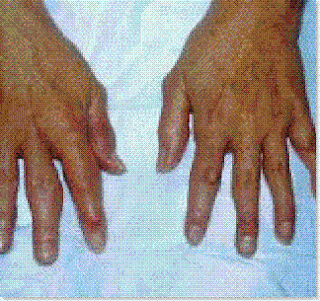
Impaired Physical Mobility NCP Rheumatoid Arthritis

Impaired Physical Mobility NCP Rheumatoid Arthritis

Nursing Care Plan for Rheumatoid Arthritis

Rheumatoid arthritis is an inflammatory arthritis and an autoimmune disease. This is where the body’s immune system attacks healthy tissues in the body, particularly the synovium the membrane joining the joints. The joints fill with fluid, due to this process and cause pain and systematic inflammation.

Rheumatoid arthritis is not only a condition linked with joints. It causes innumerable problems in other organs also such as eyes, lungs, skin and heart. Almost all of these problems are uncommon nevertheless they are crucial too, when they make their presence. Basically rheumatoid arthritis comes under the group of autoimmune diseases and hence it can make its presence in any part of the body once it catches hold of joints.

Rheumatoid arthritis is a chronic disease that may have periods of intense activity followed by a period of inactivity. Some patients may go through continuous activity that becomes worse with time. Organ damage and disability can occur with continuous rheumatoid arthritis.

The symptoms of rheumatoid arthritis come and go, depending on the degree of tissue inflammation. When body tissues are inflamed, the disease is active. When tissue inflammation subsides, the disease is inactive (in remission).

When the disease is active, symptoms can include fatigue, loss of energy, lack of appetite, low-grade fever, muscle and joint aches, and stiffness. Muscle and joint stiffness are usually most notable in the morning and after periods of inactivity.

Nursing Care Plan for Rheumatoid Arthritis


Nursing Diagnosis: Impaired Physical Mobility

Related to:
  • Skeletal deformity
  • Painful
  • Discomfort
  • Activity intolerance
  • Decreased muscle strength.
Can be evidenced by:
  • Reluctance to try moving / inability to move in with their own physical environment.
  • Limiting the range of motion, coordination imbalances, decreased muscle strength / control and mass (advanced stage).
The expected outcomes / evaluation criteria, patients will:
  • Maintaining a function of position in the absence / restrictions contractures.
  • Maintain or improve strength and function of and / or compensation of the body.
  • Demonstrate techniques / behaviors enabling activities
Nursing Intervention Impaired Physical Mobility - Nursing Care Plan for Rheumatoid Arthritis

1. Evaluation / continue monitoring the level of inflammation / pain in the joints
Rationale: The level of activity / exercise depends on the development / resolution of the inflammatory process.

2. Keep the rest - bed rest / activity schedule sit down if necessary to provide a continuous period and nighttime sleep uninterrupted.
Rationale: Systemic Rest is recommended during acute exacerbations, and all phases of the disease is important to prevent exhaustion maintain strength

3. Assist with range of motion active / passive, and resistive exercise also demikiqan isometris if possible
Rationale: Maintain / improve joint function, muscle strength and general stamina.

4. Change positions frequently with sufficient amount of personnel. Demonstrate / removal of technical aids and mobility aid use, eg, trapeze
Rationale: Eliminates stress on the network and improves circulation. Facilitate patient self-care and independence. Proper removal techniques to prevent tearing skin abrasion.

5. Position with pillows, sandbags, rolls trokanter, splint, brace
Rationale: Increase stability (reducing the risk of injury) and maintain the necessary joint position and body alignment, reducing contractor.

6. Use a small pillow / thin below the neck.
Rationale: Preventing neck flexion.

7. Encourage the patient to maintain an upright posture and sitting height, standing, and walking.
Rationale: To maximize joint function and maintain mobility

8. Provide a safe environment, such as raising the chair, using the toilet railings, wheelchair use.
Rationale: Avoiding injury due to accidents / falls

9. Collaboration: consul with physiotherapy.
Rationale: Useful in formulating training programs / activities based on individual needs and identifying tools.

10. Collaboration: Provide foam mat / converter pressure.
Rationale: Reducing the pressure on the fragile tissue to reduce the risk of immobility.

Diet Management for Rheumatoid Arthritis

Rheumatoid arthritis (RA) is a systemic autoimmune disease that has the potential for significant damage to internal organs. One of the biggest issues when it comes to treating rheumatoid arthritis is the high rate of discontinuation of therapy.

People who suffer from Rheumatoid Arthritis are no different from these people. One of the most popular lifestyle modification techniques is through making a diet plan for rheumatoid arthritis. There exist a lot of many different suggestions in terms of the diet appropriate for the diseases.

If Rheumatoid arthritis is suspected, a patient should be referred to a rheumatologist (arthritis specialist) as soon as possible. The current goal of Rheumatoid arthritis therapy is to treat and control disease before any joint damage has occurred. A rheumatologist can help by making the diagnosis and initiating disease-modifying anti-rheumatic drugs (DMARDS) to slow down disease as soon as possible.
It's important to keep in mind that most diet plans for rheumatoid arthritis does not promise to cure the diseases. Its goal is only to achieve control over the signs and symptoms of rheumatoid arthritis. In the following sections, I will be mentioning some of the popular diets followed by most rheumatoid arthritis sufferers.

• Get rid of nightshades. Among the most usual diet claims is that getting rid of nightshades, which include potatoes, tomatoes, eggplants, as well as the majority of peppers, alleviates arthritis. This diet plan is less likely to cause harm but no research to supports it.

• Alkaline diet plan. The alkaline regimen presumes that the different forms of arthritis are a result of excessive acid from the diet. Some foods to avoid in this diet are sugar, coffee drinks, red meat, and the majority of grains, nuts, and citrus fruits. Changes are observed for merely one month.

• Vegetarian diet. Some individuals describe improvement in symptoms, but evidence happens to be combined. One small research of people with RA showed improvement in four weeks, and follow-up studies of those who remained the diet plan presented improvements after one and two years.

• Switching over fats. Among the recognized correlations between food as well as arthritis happens to be that omega-6 greasy acids increase swelling, and omega-3 oily acids cut it back. This type of diet plan for rheumatoid arthritis include limitation in the consumption of meat and poultry, and increasing your consumption of cold-water fish, such as sardines, mackerel, trout, and fish.

• Green herbal tea. Drinking green tea a day may help individuals having RA. Studies funded by the Arthritis Foundation showed that the providing polyphenolic compounds in green herbal tea to mice dramatically lowered the number of cases as well as intensity of RA. Human studies have certainly not but confirmed the results. Incorporating a healthy amount of green tea in the diet plan for rheumatoid arthritis can provide relief the symptoms of the said disease.