10 NANDA COPD Chronic Obstructive Pulmonary Disease

10 NANDA COPD Chronic Obstructive Pulmonary Disease

Chronic obstructive pulmonary disease (COPD) is a general term which includes the conditions chronic bronchitis and emphysema. COPD is the preferred term, but you may still hear it called chronic obstructive airways disease (COAD).

  •     Chronic means persistent.
  •     Bronchitis is inflammation of the bronchi (the airways of the lungs).
  •     Emphysema is damage to the smaller airways and air sacs (alveoli) of the lungs.
  •     Pulmonary means 'affecting the lungs'.
The term COPD is used to describe airflow obstruction due to chronic bronchitis, emphysema, or both.

The sudden risk caused by COPD is due to the increase in people who smoke and the demographic changes in many countries. In the US, COPD is considered as the fourth leading cause of death. In economic terms the cost of the disease to the US economy in 2007 is pegged at $42.6 billion in terms of health care costs and loss in productivity.

The symptoms of COPD include: constant cough; excess sputum (mucus) production; shortness of breath while doing activities you used to be able to do; wheezing, or whistling sound when you breathe; and tightness in the chest.

The most common symptoms of COPD are breathlessness, or a 'need for air', excessive sputum production, and a chronic cough. However, COPD is not just simply a "smoker's cough", but a under-diagnosed, life threatening lung disease that may progressively lead to death.

The loss of lung function in COPD patients is so gradual that many patients do not realize that they have the condition until it is severe. By the time most patients seek medical attention, they may have lost 50% of their pulmonary function.

There is a need for greater awareness of COPD and early diagnosis and treatment can retard progression of disease and improve quality of life. A person who has COPD should adopt a number of strategies in order to manage and to combat this lung disease. Some of these important strategies include saying no to smoking, vaccinations, rehabilitation and drug therapy. Drug therapies can be done thru the use of inhalers.

The inhalers that are suggested help dilate the airways and the theophylline. Most of the time, the inhaled steroids can be used to contain lung inflammation and can suppress flare-ups. Usually antibiotics are also used during the flare-ups of the symptoms of COPD.

Nursing Diagnosis COPD Care Plan


10 NANDA - Nursing Diagnosis for COPD Chronic Obstructive Pulmonary Disease 
  1. Ineffective airway clearance 
  2. Ineffective breathing pattern 
  3. Impaired gas exchange 
  4. Activity intolerance
  5. Imbalanced Nutrition: less than body requirements
  6. Disturbed sleep pattern
  7. Bathing / Hygiene Self-care deficit 
  8. Anxiety 
  9. Ineffective individual coping 
  10. Deficient Knowledge

Nursing Care Plan for Goiter - Assessment and Diagnosis

Nursing Care Plan for Goiter - Assessment and Diagnosis

Nursing Assessment and Nursing Diagnosis for Goiter

Goiter (struma), is a swelling of the thyroid gland, which can lead to a swelling of the neck or larynx (voice box). Goitre is a term that refers to an enlargement of the thyroid (thyromegaly) and can be associated with a thyroid gland that is functioning properly or not.

A person with goiter can have normal levels of thyroid hormone (euthyroidism), excessive levels (hyperthyroidism) or levels that are too low (hypothyroidism).

A symptom is something the patient feels or reports, while a sign is something other people, including the doctor detects. For example, a headache may be a symptom while a rash may be a sign.

Some patients may have goiter and not know it because they have no symptoms.

The main symptom for a person with goiter is swelling of the thyroid gland. This may eventually become a noticeable lump in the throat. The patient may be more aware of it - a visible swelling at the base of the neck - when looking in the mirror and shaving or putting on makeup.

The following symptoms may also exist when a person has goiter:

  • Hoarseness (voice)
  • Coughing more frequently than usual
  • A feeling of tightness in the throat
  • Swallowing difficulties (less common)
  • Breathing difficulties (less common)
Nursing Care Plan for Goiter

Nursing Care Plan for Goiter - Assessment and Diagnosis

In implementing the nursing care, the authors use the guidelines as a basis for solving the nursing care of patient problems scientifically and systematically, which includes the step of assessment, nursing diagnosis, nursing Interventions and evaluation.


Assessment

Assessment is the first step in the nursing process as a whole in order to get the data or information needed to determine the health problems faced by patients through interviews, observation, and physical examination include:

a. Activity / rest
Subjective data: insomnia, muscle weakness, impaired coordination, severe fatigue.
Objective data: muscle atrophy.

b. Elimination
Subjective data: urine in large amounts, changes in the faeces, diarrhea.

c. Ego integrity
Subjective data: experiencing severe stress both emotionally and physically.
Objective data: emotional instability, depression.

d. Food / fluid
Subjective data: sudden weight loss, increased appetite, eat a lot, eat often, thirst, nausea and vomiting.
Objective data: thyroid enlargement, goiter.

e. The pain / comfort
Subjective data: orbital pain, photophobia.

f. Breathing
Subjective data: increased respiratory frequency, tachypnea, dyspnea, pulmonary edema (the crisis thyrotoxicosis).

g. Security
Subjective data: intolerance to heat, excessive sweating, allergic to iodine (may be used in the examination).
Objective data: the temperature rises above 37.40 C, diaphoresis, smooth skin, warm and reddish, thin hair, shiny and straight, eksoptamus: retraction, conjunctival irritation and watery, pruritus, erythema lesion (common in pretibial) is a very severe.

h. Sexuality
Data subyktif: decreased libido, bleeding slightly or not at all, impotence.


After all the data collected, further divided into two groups:

a. subjective data
Subjective data include: coordination disorder insomnia, changes in the pattern of elimination, the ability to handle the pressure (stress), weight loss, increased appetite, orbital pain, respiratory frequency increases, the power adjustment to heat and cold, decreased libido.

b. objective data
It is characterized by muscle atrophy, emotional instability, depression, thyroid enlargement, goiter, increased temperatures above 37.40 C, diaphoresis, nature and characteristics of the body, including hair quality situation and the state of the eye.


The next step is determining the nursing diagnosis is a statement and a real or potential problem, based on the data collected.


Nursing Diagnosis for Goiter

Nursing diagnosis in patients with goitre especially post surgery can be formulated as follows:

1. Risk for Ineffective Airway Clearance related to obstruction of the trachea, swelling, bleeding and laryngeal spasm,
characterized by:
Subjective data: pain swallowing, painful wound.
Objective data: breathing fast and deep, there are secretions / mucus.

2. Impaired Verbal Communication related to vocal cord injury / damage to the larynx, tissue edema, pain, discomfort,
characterized by:
Subjective data: swelling of the throat tissues, pain in the wound, the patient does not feel comfortable, pain swallowing.

3. Risk for Injury / tetany related to the surgery, stimulation of the central nervous system,
characterized by:
Subjective data: rapid breathing (tachypnea), wound pain.
Objective data: increased body temperature, tachycardia, cyanosis, convulsions, numbness, and infection of the surgical wound.

4. Acute Pain related to the surgery of the tissue / muscle and postoperative edema,
characterized by:
Subjective data: ask, ask for information, statements misconceptions.
Objective data: do not follow the instructions / complications that can be prevented.

CVA - Stroke Definition and Nursing Diagnosis

CVA - Stroke Definition and Nursing Diagnosis

CVA - Stroke
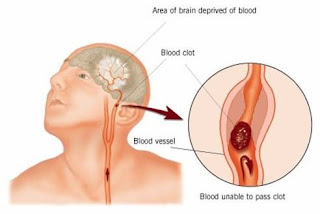
A cerebral vascular accident is another name for a stroke. It is damage to the brain caused by a disruption of the blood supply to a part of the brain. This disruption of blood supply can be caused by a blood clot, or by a ruptured artery.

The symptoms of a cerebral vascular accident depend on which part of the brain is affected. Common symptoms may include paralysis of a part of the body, loss of all or part of the vision, or loss of the ability to speak or to understand speech.

A stroke is a medical emergency and can cause permanent neurological damage, complications, and death. Risk factors for stroke include old age, high blood pressure, previous stroke or transient ischemic attack (TIA), diabetes, high cholesterol, tobacco smoking and atrial fibrillation. High blood pressure is the most important modifiable risk factor of stroke. It is the second leading cause of death worldwide.

Stroke symptoms typically start suddenly, over seconds to minutes, and in most cases do not progress further. The symptoms depend on the area of the brain affected. The more extensive the area of brain affected, the more functions that are likely to be lost. Some forms of stroke can cause additional symptoms. For example, in intracranial hemorrhage, the affected area may compress other structures. Most forms of stroke are not associated with headache, apart from subarachnoid hemorrhage and cerebral venous thrombosis and occasionally intracerebral hemorrhage.

Stroke is diagnosed through several techniques: a neurological examination (such as the Nihss), CT scans (most often without contrast enhancements) or MRI scans, Doppler ultrasound, and arteriography. The diagnosis of stroke itself is clinical, with assistance from the imaging techniques. Imaging techniques also assist in determining the subtypes and cause of stroke. There is yet no commonly used blood test for the stroke diagnosis itself, though blood tests may be of help in finding out the likely cause of stroke.

Nursing Diagnosis for CVA - Stroke:

1. Ineffective Cerebral Tissue Perfusion

2. Impaired Physical Mobility.

3. Imbalanced Nutrition, Less Than Body Requirements.

4. Impaired Skin Integrity.

5. Impaired Verbal Communication

6. Disturbed Sensory Perception

7. Self-Care Deficit

8. Knowledge Deficit

Ineffective Breastfeeding Nursing Diagnosis

Nursing Diagnosis for Ineffective Breastfeeding

NANDA definition of an ineffective breastfeeding diagnosis is the "dissatisfaction or difficulty a mother, infant or child experiences with the breastfeeding process." This can include physical discomfort as well as lack of knowledge or skill for the mother and poor weight gain for the infant.

Defining Characteristics

  • Actual or perceived inadequate milk supply (mother)
  • Arching and crying when at the breast (infant)
  • Evidence of inadequate intake (infant)
  • Fussiness and crying within the first hour of feeding (infant)
  • Inability to latch on to nipple correctly (infant)
  • Insufficient emptying of each breast
  • Unsatisfactory breastfeeding process (mother and infant)
Related Factors
  • Basic breastfeeding knowledge
  • Normal breast structure
  • Normal infant oral structure
  • Infant gestational age greater than 34 weeks
  • Support sources [available]
  • Maternal confidence
Expected Outcomes
The mother will
  • Express physical and psychological comfort in breastfeeding practice and techniques.
  • Show decreased anxiety and apprehension.
  • State at least one resource for breastfeeding support.
The infant will
  • Feed successfully on both breasts and appear satisfied for at least 2 hr after feeding.
  • Grow and thrive.

Assessment Focus (Refer to comprehensive assessment parameters.)
  • Communication
  • Roles and relationships
  • Values and beliefs
Nursing Interventions :
  1. Initiate breastfeeding within first hour after birth.
  2. Keep infant with mother
  3. Monitor effectiveness of current breastfeeding efforts.
  4. Determine support systems available to mother/family.
  5. Identify cultural beliefs/practices regarding lactation, letdown techniques, maternal food preferences.
  6. Assess mother’s knowledge and previous experience with breastfeeding.
  7. Encourage mother to drink at least 2000 mL of fluid per day or 6 to 8 oz every hour.
  8. Provide information as needed about early infant feeding cues (e.g., rooting, lip smacking, sucking fingers/hand) versus late cue of crying.
  9. Discuss/demonstrate breastfeeding aids (e.g., infant sling, nursing footstool/pillows, breast pumps).
  10. Encourage mother/other family members to express feelings/concerns, and Active-listen
  11. Educate father/SO about benefits of breastfeeding and how to manage common lactation challenges.
  12. Review techniques for expression (breast pumping) and storage of breast milk.
  13. Recommend avoidance of specific medications or substances (e.g., estrogen-containing contraceptives, bromocriptine, nicotine, alcohol).

Depression - 9 Nursing Diagnosis Care Plan

Depression - 9 Nursing Diagnosis Care Plan

Nanda Nursing Diagnosis for Depression

Depression is a state of low mood and aversion to activity that can have a negative effect on a person's thoughts, behavior, feelings, world view and physical well-being.

Symptoms
  • Sadness
  • Loss of interest or pleasure in activities you used to enjoy
  • Change in weight
  • Difficulty sleeping or oversleeping
  • Energy loss
  • Feelings of worthlessness
  • Thoughts of death or suicide
Depressed people may lose interest in activities that once were pleasurable; experience loss of appetite or overeating; have problems concentrating, remembering details, or making decisions; and may contemplate or attempt suicide. Insomnia, excessive sleeping, fatigue, loss of energy, or aches, pains or digestive problems that are resistant to treatment may be present. They may feel sad, anxious, empty, hopeless, worried, helpless, worthless, guilty, irritable, hurt, or restless.

Depression in women

Rates of depression in women are twice as high as they are in men. This is due in part to hormonal factors, particularly when it comes to premenstrual syndrome (PMS), premenstrual dysphoric disorder (PMDD), postpartum depression, and perimenopausal depression. As for signs and symptoms, women are more likely than men to experience pronounced feelings of guilt, sleep excessively, overeat, and gain weight. Women are also more likely to suffer from seasonal affective disorder.

Depression in men

Depression is a loaded word in our culture. Many associate it, however wrongly, with a sign of weakness and excessive emotion. This is especially true with men. Depressed men are less likely than women to acknowledge feelings of self-loathing and hopelessness. Instead, they tend to complain about fatigue, irritability, sleep problems, and loss of interest in work and hobbies. Other signs and symptoms of depression in men include anger, aggression, violence, reckless behavior, and substance abuse. Even though depression rates for women are twice as high as those in men, men are a higher suicide risk, especially older men.


9 Nanda Nursing Diagnosis for Depression

1. Risk for self-directed violence / Risk for Suicide

2. Ineffective coping

3. Hopelessness

4. Social isolation

5. Imbalanced Nutrition, Less Than Body Requirements

6. Self-care deficit

7. Low self-esteem

8. Ineffective sexuality patterns

9. Spiritual distress

Therapeutic Group Activities Program

Clients are treated in a psychiatric hospital or mental space is generally a complaint can not be managed at home, such as amok, silent, no shower, wandering, disturbing others and so on. After being admitted to the hospital and, the same thing often happens that many clients still, alone with no activity. Day-to-day care passed with eating, drinking and sleeping medication. There among the clients on their own initiative seek change in the situation with a walk in the hospital, but there are among those who do not know the way home so that if caught he was branded as a client who had fled then put it back into the isolation room. What exactly is done by the client??

Therapeutic Group Activities is one of the nursing actions for clients with mental disorders. This therapy is a therapy practice is the sole responsibility of a nurse. Therefore a particular nurse life nurse must be able to perform therapeutic group activities in a timely and correct.

To achieve the above needs to be an implementation guide therapeutic group activities such as group socialization activity therapy, energy distribution, sensory stimulation and reality orientation.

Goals

Therapeutic Group Activities is an attempt to facilitate a psychotherapist for a number of clients at the same time to monitor and improve interpersonal relationships between members.

In general, the goal of therapy is to improve the ability of the group's activities a reality through communication and feedback with or from others, to socialize, to increase awareness of emotional connection with the actions or reactions denfensif behavior and increases the motivation to progress cognitive and affective functions. In particular, the goal is to improve the identification, channel emotions constructively, improving interpersonal relationships or social skills.

In addition, the goal of rehabilitation is to improve the skills of self-expression, social, increase self-confidence, empathy, enhancing knowledge and problem solving skills.

Characteristics of Patients

Based on the observation and study of the status of the client then the client characteristics were included in the therapeutic activity of this group are clients with nursing issues such as the risk of injuring yourself, others and the environment, violent behavior, self-care deficits, social isolation: withdrawal, and changes in sensory perception.

Basis Theory

1. Group Activity Therapy Model

  • Focal conflic models - Developed by unconscious conflicts and focuses on a group of individuals. Task of leaders is to help the group understand the conflict and help resolve problems. Eg; disagreements between members, how the issues addressed members and leaders direct alternative problem solving.
  • Communication Models - Developed based on the theory and principles of communication, ineffective communication that will bring the group to be dissatisfied. Aim to help improve interpersonal and social skills group members. The task leader is to facilitate effective communication between members and teach the group that there is need for communication within the group, members are responsible for what is said, on all types of communication: verbal, non-verbal, open and closed, and the message must be understood others .
  • Interpersonal Models - Behavior (thoughts, feelings and actions) is depicted through interpersonal relationships within the group. In this model also describes the causal behavior of members as a result of the behavior of other members. Therapists work with individuals and groups, members learn from interaction between members and therapists. Through this process, behavior or errors can be corrected and learned.
  • Psychodrama Models - With this model can motivate group members to act in accordance with the new events occur or past events, according to the role that was exhibited. Members are expected to play a role in accordance events ever experienced.

2. Method
  • Didactic groups
  • Social Therapy Group
  • Repressive-inspirational
  • Psychodrama
  •  Group interaction-free
3. Focus Group Activity Therapy
  • Reality Orientation - The idea is to provide a therapeutic group activities with impaired orientation to person, place and time. The purpose is the client able to identify internal stimuli (thoughts, feelings, somatic sensations) and external stimuli (climate, sound, natural situation around), the client can distinguish between reverie and reality, the reality of the conversation appropriate client, the client is able to recognize himself and the client was able know others, time and place. Characteristics of clients: reality orientation disorder (GOR), hallucinations, delusions, illusions, and depersonalization that have been able to interact with others, cooperative client, able to communicate well verbally and physically in good health condition.
  • Socialization - Its purpose is to facilitate psychotherapy to monitor and improve interpersonal relationships, respond to others, expressing identical and exchange perceptions and receive external stimuli from the environment. The goal of improving interpersonal relationships among group members, communicating, caring, respond to others, express ideas and receive external stimulus. Client characteristics: lack of interest or no initiative to follow the activities of the room, often in a bed, withdrawal, lack of social contact, low self esteem, anxiety, suspicion, fear and anxiety, there is no initiative to start talks, respond as necessary, appropriate answers questions, and to build trust, willing to interact and physically healthy.
  • Stimulation of perception - Its purpose is to help clients who experience setbacks orientation, in an effort to stimulate the perception of motivating thought and affective processes and reduce mal adaptive behavior. Purpose of improving the ability of reality orientation, focused, intellectual, express opinions and accept other people's opinions and express feelings. Characteristics of clients: perceptions of disorder associated with the values, withdrawal from reality, inisiati or negative ideas, healthy physical condition, able to communicate verbally, cooperative and social activities.
  • Sensory Stimulation - The idea is to stimulate the sensory on clients who experience sensory decline. The aim of increasing the ability of sensory, focus, physical fitness, and express feelings.
  • Distribution of energy - The idea is to channel energies constructively. The purpose of destructive energies into constructive, express feelings and improve interpersonal relationships.

4. The stages in the therapeutic group activities.

According to Yalom cited by Stuart and Sundeen, 1995, phases in the therapy group activities are as follows:

a. Pre group
Starting with making goals, planning, who is the leader, members, where, when the group carried out the activities, and the evaluation process to members of the group, explaining the necessary resources such as projectors groups and if possible the cost and finance.

b. The initial phase

In this phase there are 3 possible stages that occur ie orientation, conflict or togetherness.
  • Orientation. - Members began to develop their social system, and the leader began to show treatment plan and take contracts with members.
  • Conflict - Is a difficult time in the group, members start thinking about who is in power in the group, how the role of members, duties and interdependence that will happen.
  • Togetherness - Members begin working together to solve problems, members began to discover who own.
c. Phase of work

At this stage the group has become a team. Positive and negative feelings corrected by trusting relationship that has been fostered, work together to achieve the agreed objectives, decreased anxiety, the more stable and realistic, explored further in accordance with the goals and tasks of the group, and creative problem solving.

d. Phase termination

There are two types of termination (final and interim). Members of the group may experience premature termination, unsuccessful or successful.

e. Role of Nurses in group activity therapy.
  • Preparing for group activity therapy program.
  • As leader and co leader
  • As a facilitator
  • As an observer
  • Addressing issues that arise during the implementation.

4 Techniques in Physical Examination

4 Techniques in Physical Examination

Techniques in Physical Examination

1. Inspection

Inspection is the examination done by looking at the body, which was checked through observation. Adequate light is necessary for nurses to distinguish colors, shapes and body hygiene clients. Focus inspections on any part of the body include: size, color, shape, position, symmetrical. And to compare the results of normal and abnormal body parts with each part of the body. Example: yellow eyes (jaundice), there is a goitre in the neck, bluish skin (cyanosis), and others.


2. Palpation


Palpation is a technique that uses the sense of touch. Hands and fingers are sensitive instruments used to collect data about, for example: temperature, turgor, shape, moisture, vibration, size.

The steps that need to be considered during palpation:
  • Create a comfortable and relaxed environment.
  • Nurses should be in state hands warm and dry.
  • Fingernails nurse, had to be cut short.
  • All parts are palpable pain at the end.

Ie, the presence of tumor, edema, crepitations (broken bones), and others.


3. Percussion

Percussion is tapping the examination with certain parts of the body surface to compare with other body parts (left and right) with the aim of producing sound.
Percussion aims to identify the location, size, shape and consistency of the tissue. The nurse uses his hands as a means to produce sound.

The sounds that are found on percussion:
  • Sonor: percussion sounds normal tissue.
  • Dim: percussion sound tissue, which is more dense, such as in the lungs in pneumonia.
  • Deaf: percussion sound tissue, dense as on percussion area of ​​the heart, liver area percussion.
  • Hipersonor / timpani: percussion sound more hollow areas, such as lung Caverna area, the client chronic asthma.


4. Auscultation

The physical examination is done by listening to the sound produced by the body. Typically use a tool called a stethoscope. The things heard are: heart sounds, breath sounds, and bowel sounds.

Abnormal sound that can be auscultated in breath are:

Rales: sound produced from the sticky exudate while subtle channels of respiratory expands on inspiration (rales fine, medium, coarse). For example, the client pneumonia, tuberculosis.
Ronchi: low and very rude tone sounded both during inspiration and expiration time. Characteristic ronchi is lost when the client coughs. For example, in pulmonary edema.
Wheezing: sound an audible "ngiii .... k". can be found in the phase of inspiration and expiration. For example, in acute bronchitis, asthma.
Pleural Friction Rub; sound that sounds "dry" sound like rubbing sandpaper on wood. For example, the client with pleural inflammation.